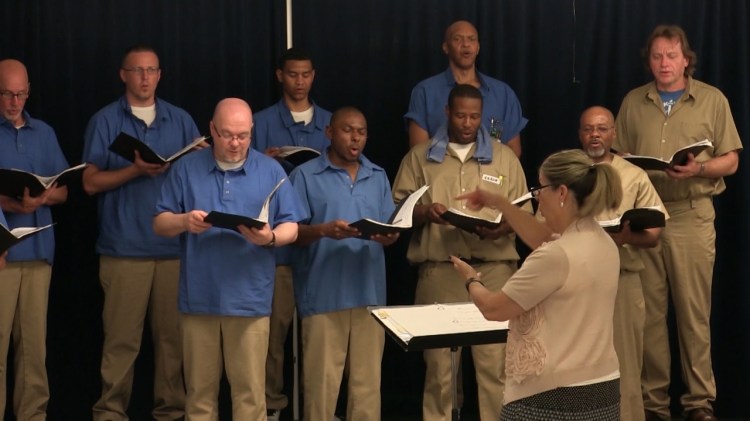
Only a few short weeks after OMAG’s performance for Family Visitation Evening, we geared up for our second annual Spring Musicale in the Visitation Room of the Hope Center at the Grafton Reintegration Center. I had sent invitations to colleagues, friends, prisoner advocates in the Cleveland area. The men invited their family and friends. Our special guests were the Finney Oberlin Singers (a “pick-up” group of 12 men from the Oberlin Conservatory of Music & First Church in Oberlin UCC that I directed only for this occasion).
As I wrote in an earlier post (See “Light-Switch Moments”), the OMAG singers had reached an all-time high: confidence, security in singing a song in 3-part harmony, tackling more challenging repertoire, matching pitches and rhythms, and singing as an ensemble rather than a bunch of individuals. Their peak experience of the Family Evening continued to “flow” into the Spring Musicale 2017 performance.
After we sang, the men engaged the audience in a few minutes of “talk back.” I took this post-performance strategy from my sister colleague, Dr. Phyllis Gorfain, Founder/Director of Oberlin Drama at Grafton (ODAG), who beautifully implements talk-backs after each theatrical performance. Audience members dialog with the actors, in our case singers. The men articulated their learning patience, working collaboratively within the group, (my pushing them into new and sometimes “scary” musical things!), and the learning and “humanity” benefits to self by participating in choral music. It was an opportunity for the men’s individual voices to be heard.
SPRING MUSICALE 2017
Oberlin Music at Grafton (OMAG) Choir
All Things Bright and Beautiful Philip E. Silvey
Beauty Before Me Kristopher E. Lindquist
There is Peace Jim Papoulis
What a Wonderful World George David Weiss & Bob Thiele
OMAG Choir
Little Innocent Lamb Spiritual/arr. Marshall Bartholomew
Be Thou My Vision arr. Robert Hunter
Till the Stars Fall from the Sky Sally K. Albrecht/arr. Jay Althouse
Finney Oberlin Choir
Wade in the Water Spiritual/arr. Moses Hogan
Frobisher Bay James Gordon/arr. Braeden Ayres
And So It Goes Billy Joel/arr. Audrey Snyder
May the Stars Remember Your Name Kenneth Bailey/arr. Mary Cohen
OMAG Choir
Shine on Me Spiritual/arr. Rollo A. Dillworth
It Don’t Mean a Thing Duke Ellington & Irving Mills/arr. Roger Emerson & Robert Bellisario
Many of you might remember ABC’s Wide World of Sports that aired each Saturday afternoon in the 1970s. Jim McKay’s voice narrated, dramatic music played, while the visuals showcased the variety of sports events covered in the show. As a child, I was in awe of the strength and excitement of the athletes, but invariably, I couldn’t wait for “the agony of defeat” moment when a ski jumper completely wiped out at the point of take off. How could anyone survive such a crash? The defeat was as exciting as the other athletes highlighted in the show’s intro. (Vinko Bogataj, the skier, only had a concussion and broken ankle, by the way.)
It was March 3, 2017. My husband and I eagerly sat in front of the television. It was a “great victory”—OMAG would be showcased on the Cleveland PBS station, WVIZ. It had been months filled with preparations, details, special permissions, and audiovisual editing. As the introduction to the story began, I began to hoot and holler. Then I held my breath. What if this story would not be true to the OMAG story. Suddenly I realized this could be disastrous! I had not had a chance to preview the video.
The OMAG segment link appears below. As I watched, I thought, “Ok, this isn’t bad. It’s a sterilized view of what we do, but it is sensitive and respectable.” Truth be told, I was quite weepy throughout the 7-minute segment. Tears of joy and thinking of the special singers in the OMAG choir and what we do together each week. At the following OMAG rehearsal, I was excited to ask the question, “So, what did you think?” Then, the agony of defeat: SILENCE, followed by hands raised and men saying that there wasn’t enough of the actual OMAG story, not enough of the music, too many “stock” photos from the Ohio prison system that weren’t even from Grafton, no mention of their rehabilitation and hard efforts. Then one member said, “No offense, Jody, you’re a nice person, but you talked too much.” Ouch! Their criticisms were valid, of course, but I thought they’d be really excited that some of their story was made public. I felt awful. I told them that their faces couldn’t be shown in the segment and that I expected the segment to have an impact on those who saw it on tv and heard the audio on the radio. What is one person’s victory, can be another person’s defeat. In time, I hope the men can come to see this experience as a neutral, even positive, one.
During the Spring season of OMAG, we worked to prepare for our contribution to the Chaplain’s service as a part of the Wednesday evening Family Visit Evening. During that occasion, we were asked to provide approximately 25 minutes of music. As is typical of Family Evening, there are chairs and clear plastic tables set up, around which families gather to visit with one another. For some “residents,” the visit signifies the first family visit in a very long time. For others, it is a monthly opportunity for children, siblings, parents, and wives/girlfriends to visit their incarcerated father, son, brother, boyfriend/husband. The occasion, as you might expect, is marked by lots of conversation converted into high volume sound. It takes a bit of time for the Chaplain to gain everyone’s attention, because folks are naturally eager to visit with each other.
OMAG’s turn to sing. Quite a few of the singers invited their family and friends to this particular Family Evening, since they wanted their “own” to witness their participation in the OMAG Choir and creation of musical interpretation. At first, the men were tentative in their first phrases of song. At one point during “All Things Bright and Beautiful” the light switch turned on! The men recognized the precise, full, sensitive sounds they were producing collaboratively. Their eyes honed in on my conducting gestures while their voices responded accordingly. Then they began to make eye contact with each other in order to coordinate their pitches, rhythms, and dynamics. We smiled at each other and relaxed. We were in the groove. And with each song they were more confident, expressive, and “together.” So what is more powerful than a person finding her/his own light-switch (flow) experience? When a group of artistic souls simultaneously achieve the flow experience. The singers’ body, mind, and spirit selves were completely engaged in the moment. The more confidence and musicality they exuded, the more the audience was pulled into the performance. Given the number of people in the Visitation Room for the Family Evening, it was amazing that the singers’ music captured their complete attention.
The songs we sang were:
All Things Bright and Beautiful (Silvey)
Frobisher Bay (Gordon/arr. Ayers)
Wade in the Water (Spiritual/arr. Printz)
What a Wonderful World (Weiss & Thiele/arr. Lojeski)
A person, who was an OMAG singer’s guest, wrote to me:
“In over 20 years in ministry, that [OMAG Choir performance] may be one of the most powerful things that I have witnessed. Music brought life to my friend (resident’s name). He and all the other inmates were so pleased with what they were able to do. They love Dr. Kerchner, and by the way they sounded great! Overall the evening moved me and gave me hope for today and the future.”
Caroling, caroling through the snow Christmas bells are ringing Joyous voices sweet and clear Sing the sad of heart to cheer Ding, dong, ding, dong Christmas bells are ringing.
Santa hats donned. OMAG folders in hand. Officer and Programming Director as guides. OMAG sets forth through the bitter cold and occasional snowflake to spread good holiday cheer. But who is there to listen? A few dental and medical assistants, an education officer who turns us away due to standardized testing going on in the building, a few media center inhabitants, and (from the outside looking in) a visitation room hosting family members and residents. OMAG stands in the cold outside the windows peering into the visitation room while those inside witness what might appear as our joyful pantomime. Who can hear us? Who will hear us? We are invited inside the room after several carols sung outside. A little girl is excited to see the Santa hats. She requests us to sing “Rudolph the Red-Nosed Reindeer.” We oblige. The little girl, her younger sister, and her incarcerated father begin to dance together in the Visitation Room. The OMAG men are clearly moved by this shared happiness.
Then what to our wondering eyes should appear, but an invitation by the Programming Director and Officer to sing in two of the three men’s “dorms” (i.e., “blocks”, “cells,” living spaces). Again, we oblige. The first dorm’s halls are duly decked for the Christmastide. Beautiful paper snowflakes (made by the residents) hang from the ceiling. The residents gather to taste our cups of good cheer. Communal singing and applause. Off we go to Dorm C2—the “rowdy dorm.” “The ‘rowdy dorm’?”, I inquire. “Is it like a large group of middle-schoolers? I can handle that!” The Officer stated, “Yes, immature and more.” The Program Director assured me that she “had my back” in case anything should go wrong. The OMAG singers were hesitant to enter, but “caroling, caroling now we go…” By contrast, this dorm had no decorations and few men outside of the “window.” The OMAG men were eager to share what existed behind the window. Gonna find out who’s naughty (or nice)…bunk bed, after bunk bed, after bunk bed in extremely close proximity. The guys explain that they cannot extend their arms in their cots without touching someone else on the next bunk. I digress. The OMAG singers begin singing, and a few men here and there enter into our space to hear our songs. On occasion there was humming along that could be heard and even occasional applause. Certainly a different vibe. And then we sang “Silent Night.” One could have heard a marshmallow drop in this not-so-rowdy-but-silent dorm. More men joined the throng of listeners, although I didn’t notice at the time because my back was facing them because I was conducting. Silence among noise, anger, frustration. Humming. Tears. Bowed heads. This was my winter scene when I turned around to the audience.
Back at the Hope Center where OMAG rehearses, the men enjoyed time together while eating Christmas cookies and drinking hot cocoa. We sat around and shared stories of past Christmas dinners (and my cooking experiences). The men reflected on the little girls dancing and the men in Dorm C2’s attention. One person mentioned that even if he never gets released his goal is to somehow make an impact. Another man mentioned that God’s plan for them is to reform and make differences whether they are inside or outside. Another man queried whether or not they could or should ever be forgiven. Others chimed in about second chances and the “outside” view on redemption and healing. I was the non-participant observer, wanting to learn from the men in our circle of hot cocoa and trust. The conversation turned to pondering the “hard work” of rehabilitation and if their change in mindset, behavior, and being would ever be fully noticed by those who oversee them as wards of the state and society at large. One person noted that they are not US citizens because they are wards of the state (metaphorically stated). Another mentioned that he had done vile things and all “bad” things have victims, seen or unseen, and that they are getting exactly what they deserved. Another man offered to pray for the man who had just made that statement, because “Jesus is forgiveness, and God gives me a second chance, whether others see it and believe it.” Ok, I was not expecting the seriousness and the profundity of this conversation that stemmed from caroling. Hey guys, it’s a celebration! And it continued. Talk of crime, punishment. One person mentioned that prison reform and release must be based on “humanity.” That those who hold power in the prison system must begin to see the men as individuals with the possibility of change, instead of the crime that they once committed. They mentioned the need for education, learning new skills, broadening their expressive opportunities, and gradually being released back into society, instead of being given $75.00 and full release on a particular time and day.
Then I insert my question: “How do you think your personal reform and our sharing music made an impact big, small, or unnoticed today?” Further, “Does it matter that anyone else recognizes reform?” (Yes, to the extent that the observed reform leads to release). We talked about big impact and change taking time, energy, persistence, and passion, and that it begins internally before that energy can affect the external. Then we concluded the cocoa-klatch with one man giving a recitation/reading of something he copied in handwriting from Khalil Gibran’s “The Prophet.” Alas, we never got to our rehearsal. Or maybe we were rehearsing for bigger and better things…
Then said a rich man, “Speak to us of Giving.” And he answered:
You give but little when you give of your possessions. It is when you give of yourself that you truly give.
For what are your possessions but things you keep and guard for fear you may need them tomorrow? And tomorrow, what shall tomorrow bring to the over prudent dog burying bones in the trackless sand as he follows the pilgrims to the holy city? And what is fear of need but need itself? Is not dread of thirst when your well is full, the thirst that is unquenchable?
There are those who give little of the much which they have- and they give it for recognition and their hidden desire makes their gifts unwholesome. And there are those who have little and give it all. These are the believers in life and the bounty of life, and their coffer is never empty. There are those who give with joy, and their joy is their reward. And there are those who give with pain, and that pain is their baptism. And there are those who give and know not pain in giving, nor do they seek joy, nor give with mindfulness of virtue: They give as in yonder valley the myrtle breathes its fragrance into space. Through the hands of such as these God speaks, and from behind their eyes He smiles upon the earth.
It is well to give when asked, but it is better to give unasked, through understanding: And to the open-handed the search for one who shall receive is joy greater than giving. And is there aught your would withhold? All you have shall some day be given: Therefore give now, that the season of giving may be yours and not your inheritors`.
You often say,”I would give, but only to the deserving.” The trees in your orchard say not so, nor the flocks in your pasture. They give that they may live, for to with-hold is to perish. Surely he who is worthy to receive his days and nights, is worthy of all else from you. And he who has deserved to drink from the ocean of life deserves to fill his cup from your little stream. And what desert greater shall there be, than that, which lies in the courage and the confidence, nay the charity, of receiving? And who are you that men should rend their bosom and unveil their pride, that you may see their worth naked and their pride unabashed? See first that you yourself deserve to be a giver,and an instrument of giving.
For in truth it is life that gives unto life- while you, who deem yourself a giver are but a witness.
And you receivers- and you are all receivers- assume no weight of gratitude, lest you lay a yoke upon yourself and upon he who gives. Rather rise together with the giver on his gifts as on wings: For to be overmindful of your debt,is to doubt his generosity who has the free-hearted earth for mother,and God for father.
(Gibran, The Prophet, 1923, Alfred Knopf Publishers)
In any long-term human relationship—with best friends, family members, spouses, students, community members—we invariably experience times that are “bumpy.” Although uncomfortable for brief or perhaps longer periods of time, I suspect these moments of potential volatility occur as a way of realigning, rebalancing, our relationships. One person might present a statement or do something with which we do not agree, one person might say something and that person’s intent is misunderstood, or one does or says something that is hurtful or harmful. These points of tension provide us with imbalance in our feelings and physical being. The person on the “receiving” end often meets the “misdeeds” with anger, frustration, mistrust, fear, or disappointment. The person on the “giving” end of things might temporarily (or unrelentingly) feel vindicated or, on the opposite end of the spectrum, ultimately feel guilty or remorseful. I believe that all parties in a relationship consciously (or subconsciously) create and contribute to the conditions that lead to the emblazoned situations. Ideally, however, these tension points can also present themselves as opportunities for the relationships to grow through renewed understanding, compassion, and commitment.
The other week, one of the OMAG members gave me a multi-page, handwritten letter to “read after rehearsal, not now” before rehearsal began. I put it in my clear plastic music bag, and promptly forgot to read it until three days later, just before OMAG was to perform during lunch for the Vera Institute of Justice Visitation Day. Why did I think it a good idea to read the letter during the Visitation Day opening remarks? Sitting and reading the letter, I felt my face get hot and tears forming in my eyes. I thought I could control them, but alas, the waterworks began. In the letter, that ungrateful critic called into question my commitment to OMAG, given how “busy” I am. His main beef was that OMAG didn’t have any rehearsal time in addition to the established Friday afternoon time. Futhermore, his complaints included that there was too much time spent on physical stretching warmups before singing, a lack of seriousness among some of the other singers (imagine that they want to be in choir for the social aspects!), and that there were several advanced musicians in the group who needed to be challenged by singing in a chamber group (note that this group would rehearse during an additional meeting time during the week). The letter felt so oppositional. Let’s just say that I was so angry and hurt that I couldn’t look at him during our Visitation Day performance.
Fast forward to the conclusion of the next OMAG rehearsal. I told the letter-writer that we needed to talk. He took me to a room where we sat across from one another. Now, amidst stewing and brewing in between our performance and the rehearsal, I was able to remember that this person is a trained musician. He describes music as his “heartbeat.” Prison is made somewhat tolerable for this person only because he has access to an instrument, and he teaches a music class. He has been a source of recruitment, communication, and musical expertise from OMAG’s inception. Frankly, I rely on him to do extra brush-ups on parts with some of the insecure singers and to arrange musical parts to fit the singers’ voices. Anyway, I once again realized that he would try everything in his power to have extra rehearsals and time away from “prison life”, by engaging in music. Ok, so the raging fire in my heart was repurposed into a fire of occasional compassion.
Our conversation ensued. I firmly told him how angry and offended I had been. He acted surprised. I told him that I could not give more to OMAG than I already was. I work full-time and that’s my primary gig. I spend lots of time each week preparing, researching, writing about, and presenting information to others about OMAG and prison reform! How dare he! I told him that I understood if he needed to leave the OMAG choir, because of his dissatisfaction with its current operational policies (i.e., anyone who wants to sing in the choir will be accepted into the choir). I told him that I appreciated his contributions, but clearly the letter reflected opposition and that I would not have that in the OMAG choir. He back-pedaled. He was complimentary and restated that he had “no intention” of being offensive. He was just being helpful by giving a list of suggestions. I asked if we could move beyond this, and he said we could. Ok, that went fairly well. Except….
Unknowingly, the room in which we spoke was adjacent a prison administrator’s office. The door was open. The administrator overheard every word of our conversation. They said they needed to speak with me in their office. I felt sick to the stomach. The resident looked like he was sick to his stomach. This wasn’t going to end well.
“Dr. Kerchner, take control of your choir!”, commanded the prison administrator. My knees began to shake. I told them that my conversation was between the singer and me. They “corrected” my statement by saying it was between the singer and the prison, since they were responsible for my safety and volunteers being treated well. They were not mad at me, but their face was fire red and the tone of their voice was clear: they wanted this singer out of OMAG. I stated that I wanted to work with him and that I had told him my “piece,” but the administrator was completely incensed that he—a prisoner—would have the nerve to criticize something for which he should be “just grateful.” After all, what is he? An offender. Had he made the right choices on the outside, he wouldn’t be on the inside now. Again, the administrator was on my side, talking about respect and boundaries and that they, too, would be speaking with this singer that same evening. At one point, they pointed their index finger on their desk and asked, “Do you understand me?” I felt my lips freeze, but a soft child-like voice emerged from inside of me, saying,”Yes.” “What did you say?” “Yes, ma’am!” They lightened up when our conversation was over. Did I mention that my lips never moved?
My student assistant waited outside the rehearsal area. She saw me and asked, “Are you ok, Dr. Kerchner?” I responded, “I think so, but I don’t know!” I hadn’t been spoken to in “that tone” since I was about 5 or 6 years old. I felt sick, really sick from worry. I had been mad at the letter-writer, but in no way had I wanted harm to come to him. It was clear that he would be “spoken to,” if not worse. I feared he would be sent to “the hole”—solitary confinement. And, I wouldn’t know until the middle of the next week, if anyone had seen or heard from him. What if I had caused something awful to happen?
As it turned out, he was spoken to (in no uncertain terms) about staying in his place within the OMAG chain of command. Wait? Is there a chain of command in my group? In prison, ultimately, there “must” always be a chain of command. Everyone knows who is at the top and who is at the bottom of (or below) the heap. This singer had crossed boundaries, and I responded accordingly. He was surprised at the intensity of my fire. I had been surprised by the intensity of the prison administrator’s fire. Amazing how the singer’s fiery frustration, ignited my flaring emotional response, and ultimately the prison administrator’s fully engulfed response. There was nothing spontaneous in this combustible relationship. We each contributed our individual and collective prior history, ego (a wise sage defined it as “camouflaged fear”), style of engaging people, and our (mis?)interpretations of intent. For now the flames have been mostly exhausted…only future interactions will determine if the flames are extinguished or ready for ignition when another source of fuel is added. For now, we know each other’s positions. New understandings. Return to balance. Or?
I might have been called many things in life, but never before a “freak of nature.” This was the loud comment offered by an OMAG (Oberlin Music at Grafton) prison choir member after I sang through the first song we would learn together, “Circle of Life” (NOT The Lion King version!). I politely asked him to explain what he meant by his exclamation. Meanwhile, the other residents sat awaiting something…a confrontational moment? a laugh? hurt feelings? my embarrassment?
The choir member continued, “Where did you find them notes to sing? You just looked at the paper [the score], and you started. It’s like you just pulled those notes out of your ear, out of your head.” Hmm…I needed to know a bit more. I asked if he could sing a song or part of a song at that very moment. His body retreated somewhat, so I sensed a bit of discomfort. I assured him that he didn’t need to sing by himself for us. Still, could he? He nodded his head “yes.” I told him that I had just done the same thing: I knew the song and sang it. Another singer noted that just as we think words in our minds, we can remember and sing melodies and whole songs in our heads. Several other singers told me they wanted to learn to do what I had just done. I told them that it takes time and practice. Another resident reminded the others that some people are born with “that perfect pitch thing.” I told them that I had developed a strong sense of relative pitch.
Then came a bit of frustration. “We can’t do what you do.” “You have talent that we don’t.” “You have more training than we do.” I asked one singer what his talent was. He quickly stated that he was a carpenter, and I told him I could perhaps learn to do some things involving carpentry, but that I had never spent the time to learn. Also he was probably more innately talented than I was. The guys were not convinced. So, how was I going to reel in this conversation?
I asked the singers if everyone could hear out of both ears. They all said or nodded “yes.” Then, I pulled out my hearing aid and dangled it in front of my face. I told them that they brought two ears to their singing, while I brought one and a slight portion of another. The room went silent. One person said, “I’m sorry to hear that.” I told them that I didn’t seek sympathy, but I did want them to know that we were all bringing our own unique gifts to the choir. The conversation turned to discussing “glasses that are half empty or half full” and “perspective.” Then came the profound statement from one singer who had yet to speak in the rehearsal: “If you can’t envision the sound in your head, you can’t sing it. Just like if you can’t see yourself changing, you won’t. It’s the perspective you hold.”
With that, we learned the song, and there was nothing freaky about it.
Finally, my choir information/registration session at prison had arrived! I hadn’t slept much the night before. My mind was racing with a million questions, scenarios, and options for the session “plan.” I had my driver’s license as identification, I had worn conservative clothing, and I had received clearance to take a notepad and pen. I was as ready as I would ever be.
I was still escorted and supervised, since I had not yet been officially trained as a “volunteer.” My ODAG (Oberlin Drama at Grafton) colleague and I entered an “L-shaped” space with eight tables, each having 3 chairs. Off to one side of this main space was an attached room, theoretically an area in which we could have sectional rehearsals. There were two other smaller rooms attached to the main space—one was the sewing room, the other a woodworking shop.
My heart sank: only ten residents showed up for our gathering. They informed me that the posters announcing the meeting went up in only one of the three dorms. But, I had even met with the folks who would create and distribute the publicity. And, what happened to the Hope TV Channel publicity that would advertise the choir? The paperwork had clearly entered the institutional black hole. Ten people? Hardly a choir. Would OMAG be canceled even before it ever began?
But, there were 10 men. Not bad for having no “word out on the street.” The residents explained that this particular meeting time conflicted with work, school, and residents’ other obligations. They also assured me that there was much more interest in the choir than those who actually showed up for the meeting.
I distributed a survey, so I could learn of the residents’ musical background, interests, and reasons for wanting to participate in the choir. I’d like to share the residents’ responses to the survey question, “Why do you like to sing?” (NOTE: I have not edited the responses.)
“I been singing all my life, and I like to heal the souls of people, including mine.”
“I like to harmonize.”
“I like to learn new things and I sung in a church as a kid.”
“It makes me feel.”
“Because I am good at it and singing takes me to another place where I am at peace with myelf at all times.”
“It feels good to express love for music through voice.”
“Nostalgia. Singing brings back good old days and times in my life where I was doing exciting things, good times, having fun.”
“It gives me a natural high.”
“Because it changes my mood.”
“It’s my heartbeat.”
Healing, harmonizing, learning, feeling, remembering, altering moods, and simply…being. These words conveyed why these men had come to sing. These reasons are similar to any reason those of us who are not incarcerated could have articulated for why we enjoy singing. These were ten men—yes, ten prison residents. Ten human beings, capable of thinking and feeling deeply. Music would be our vehicle and common experience that we would share. When I glanced over the surveys as the residents handed them to me, I knew then that I would sing with whoever came to any particular rehearsal—1, 50, or…, yes, 10.
“Courage is what it takes to stand up and speak; courage is also what it takes to sit down and listen.” ~Winston Churchill
As a music education researcher, I consult primary sources to inform my research methodology and analyses. What and who would be my primary sources now that I was grappling with rather “big picture” issues involving starting an all-male prison choir? Three issues were at hand:
Gender
Race
Relevance
Certainly, my collegial, female compadre who had started the drama program at the prison extolled the benefits of working with the residents. She assured me that she had never felt unsafe or threatened…ever…while interacting with the residents. And, frankly, having observed her work with the guys, I think no one would ever harm her. She is this petite bundle of energy, strength, and compassion. She has a strong bond with the residents resulting from their work on plays and circle-of-truth discussions. Such a passionate advocate! It is clear that she is a giant and heroine of their story. So, no worries…that I identify with being female will be a non-issue. Or?
Enter the African-American, male, Pentecostal pastor who graciously agreed to meet for lunch to discuss his experiences as Chaplain at the Grafton prison. This veteran pastoral sage provided advice such as : 1) Establish boundaries before you ever step in front of the singers, 2) Be aware of your surroundings, 3) Know that anytime one enters a prison, one is placing oneself in a space of potential danger, and 4) (I’m blushing as I write this! His words, not mine!) “You’re a female, and a rather attractive one at that. They could very well see you as a sexualized object.”
Enter the (white) male pastor of the United Church of Christ congregation to which I belong. Over coffee, he mentioned, “I think you are just the person to do this.” His sage ideas included: 1) You’re not there to judge. You are there to make music., 2) You never know the form that ministry will take., 3) You don’t have to relate to the residents based on shared life experiences. The connection will be the music., and 4) This might just be the time in your life for this project. Why not?
Finally, enter an acquaintance, who is an intuitive, white, female psychologist extraordinaire. She gave me her sage perspective: 1) Be aware of your body position relative to the residents at all times., 2) Examine your real reasons for wanting to work with the residents. Are you trying to be a saviour? A caregiver? A martyr?, 3) “These men have not seen or been with a woman for a very long time. You might be trying to conduct music and bring beauty into the residents’ lives, but know that they’ll be looking at your legs.”, and 4) “These are broken people, not bad people.”
The people have spoken. Would I demonstrate the courage to listen, process, and implement this sage advice as I go forward thinking about this choir, what it would “look like,” the boundaries I would define, and the role I would assume? Standing up for prison reform is relatively easy. It’s listening to the sages that’s proving to be difficult.
“What’s in a name? That which we call a rose by any other name would smell as sweet.” ~William Shakespeare, Romeo and Juliet, Act II, Scene II
Names and labels. Shakespeare’s Juliet spoke the words that opened this post to Romeo, who just happened to have the “wrong” last name. He’s a “Montague,” not a “Capulet.” Yet she argues that names of things or people do not affect what or who they are. Romeo is Romeo, regardless of his last name.
Who am I to challenge dear Juliet, let alone Shakespeare, but I do believe names and labels that we are given and we embrace do affect our concept of who we are. But labels define just part of a person’s story. Labels are names given to things and people to create cognitive (and societal) order by categorizing things that are “similar,” and, consequently, “different.” Learning this process begins early in our childhood. Think about the Sesame Street song, “One of These Things.” The lyrics below say it all:
“One of these things is not like the others, One of these things just doesn’t belong, Can you tell which thing is not like the others By the time I finish my song?”
In my teaching, I have seen the effect of labels on students’ progress toward achievement, identity, learning agency, and confidence. A student who is told that she/he is “lazy,” “slow,” “autistic,” “gifted,” “cooperative,” or “underprivileged” tends to live up to the potential expectations that society attaches to the labels. This indoctrination leads to students’ self-fulfilling prophecy for better, and often, for worse. In our collegiate music teaching methods courses, we discuss the difference between saying, “This child is learning disabled” and “This is a child with learning disabilities.” The first statement implies that the whole child is “learning disabled.” Contrarily, the second statement implies that there is a portion or some facet of the child’s being that is described as “learning disabled.”
In my last post (“They’re not there because they cheated on a math test”), I mentioned that I had difficulty facing the labels that had been given to my potential Oberlin Music at Grafton (OMAG) prison choir members. “Murderer,” “rapist,” “robber,” “assaulter,” “child corruptor” are just some of the labels attached to the singers. Juliet would suggest that you call them what you want, but the descriptor (label) doesn’t affect the person. Doesn’t it? The more one hears a name or a fact (correct or incorrect), the more people believe it to be the truth. If one is called a “robber,” one might assume that the label is the whole of her/his identity, thus perpetuating undesirable behaviors and thought patterns associated with the word, “robber.” How does one envision and subsequently create the “best possible self,” if that “best possible self” contradicts the label determined by the penal system?
The first time I heard the word, “resident,” referring to the incarcerated people at the Grafton Reintegration Center (GRC), I thought, “Oh, it’s prosocial to refer to the men as ‘residents’.” I had only ever known incarcerated people to be called prisoners, inmates, criminals, or worse. My next thoughts vacillated between “Call them what you want to call them. They’re still prisoners” and “Residents? This prison is a gated community, but certainly not in a luxurious location.” Residents? The word “resident” simply describes someone who dwells in a location. The judgment inherent in words such as “prisoner,” “inmate,” and “criminal” is removed in the use of the word “resident.” My role in directing the OMAG choir would not be as a judge, but as musician and human. This mindful shift in perspective is helping me find the courage to remain aware, while also finding the common humanity that I want to unearth through making music.
In my last post (“Where did this come from?”), I wrote that I was toying with creating a choral ensemble in a rather unusual space—prison. After letting the idea percolate for a few days, my optimistic and altruistic spirit dominated my thinking and feeling about this unique opportunity that crossed my professional and personal lives.
Sitting on the patio on a warm, summer’s evening (with vodka & tonic in hand), I was pontificating with my captive audience member—my husband—about the potential of my bringing meaningful musical experiences to the “residents”, bringing the aesthetic into a space (the prison) that might not exude much beauty (my assumption), and having the residents explore yet another part of their humanity through music. Then it happened: I heard the voice of reason, and it wasn’t mine.
“Umm, they’re not there for cheating on a math test.” My husband calmly uttered this sentence, and I was immediately faced with the reality of the ensemble’s clientele. Even the worst behaviors I have witnessed in others—the liar, the manipulator, the spousal cheat, the womanizer, the sarcastic and dehumanizing verbal abuser, the backstabber, the out-of-control temper, the arrogant S.O.B., the attention-getting greed monger, and over-ambitious self-promoter—do not compare to the felony crimes the prison residents had committed and for which they had been convicted. How would I ever wrap my head around this fact? How could I relate to who they are and what they had done? How could I look them in the eye and attempt to bring joy and learning opportunity to them?
Crime and punishment. Sure, I watch James Spader (FBI fugitive, “Red” Reddington) & Megan Boone (FBI agent, Elizabeth Keen) bring down the creepiest people in the world on NBC’s “The Blacklist.” (Ok, I also admit to a few episodes of “Hawaii 5-0” and “CSI: Miami”, too!). I read the horrific stories of crime that consistently invade the front pages of our newspapers and view the scrolling headlines of CNN or any daily local newscast. Now crime was close to my world. Maybe these were the “nice” felons that I would direct in the choir(?)
Pulling my head out of the sand was difficult for me. I WANT to trust people. I WANT to see the good in people. And as Dorothy stated to her dog in “The Wizard of Oz”, “I don’t think we’re in Kansas anymore, Toto!” Denial is a wonderful thing, until it becomes dangerous to your own personal and emotional well being. No, the residents did not cheat on a math test (well, maybe they did!), but my cadre of singers did assault, rob, murder, rape, and corrupt. These residents had done terrible things to other people and their families. How could I/would I come to terms with the realities of their lives that were about to intersect with mine?








 Singing Behind Bars
